

In 1948, Arthur Miller took a trip to southern Italy with his Italian-American friend Jim Longhi, a native of Lucera. The experience of their trip to the Gargano region forms the autobiographical core of the short story “Monte Sant’Angelo,” first published in 1951 in Harper’s Magazine and later revised for the collection *I Don’t Need You Any More*, published in 1967. The relationship between real-life experience and literary invention has also been reconstructed through Longhi’s own accounts, collected many years later, which made it possible to link the story’s protagonists to the two real-life travelers: Longhi to Appello and Miller to Bernstein.
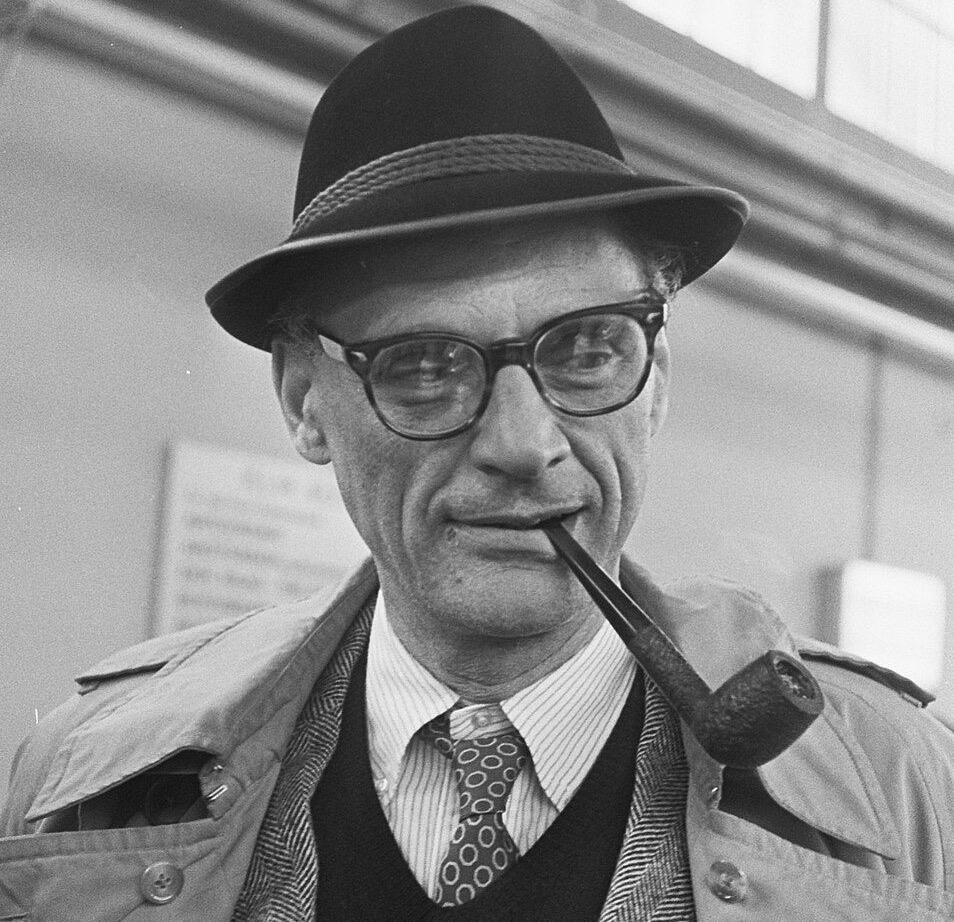
Monte Sant’Angelo as a Place of Search for Belonging The story does not merely record the impression made by Monte Sant’Angelo, but transforms the journey into a reflection on memory and the sense of belonging. Appello arrives in the town in the Gargano region in search of his family roots and the graves of his ancestors, while Bernstein initially adopts a detached attitude toward him. His friend’s quest, however, ends up drawing Bernstein in as well, forcing him to confront his own situation as a man lacking a family memory that he perceives as fully shared.
The town and landscape surrounding the Monte Sant’Angelo sanctuary are depicted in the story as a rugged and isolated place, suspended between the rocky landscape of the Gargano and the monumental presence of the sanctuary. The description of the town and its streets serves more than just a setting: the harshness of the place accentuates the protagonists’ sense of distance from their familiar, American world. The sanctuary and the town thus function as an “other” space, where individual memory is set in relation to a much older history. The Monte Sant’Angelo Public Library effectively captures this dimension by describing the town as a “turreted eagle’s nest,” an image that encapsulates the sense of isolation and verticality of the setting as portrayed in the story.
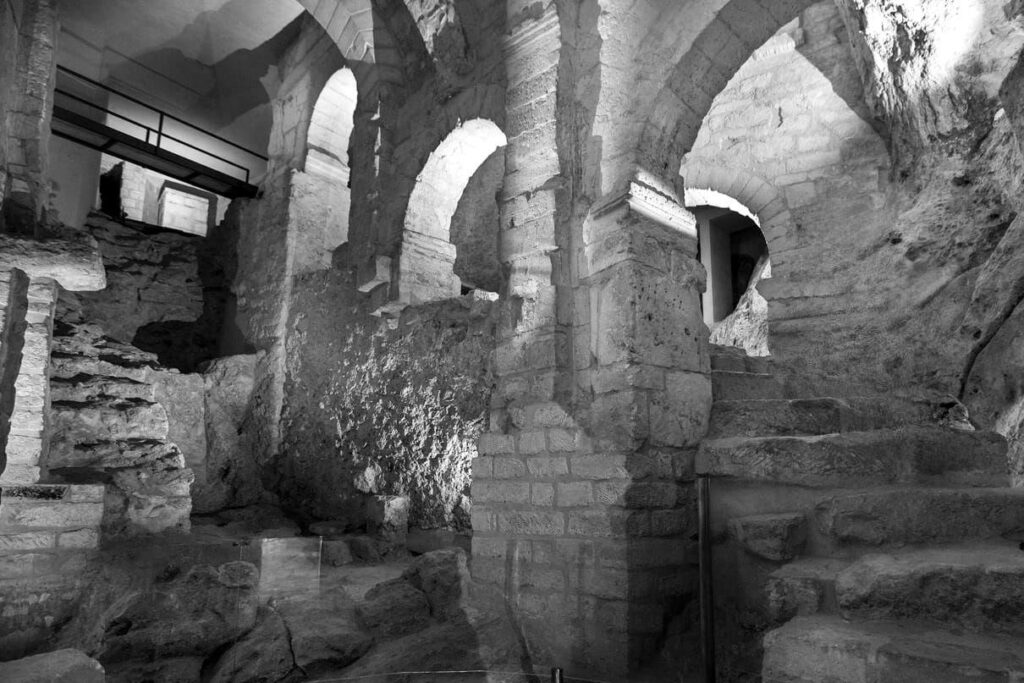
The Crypt and the Search for Ancestors One of the central moments of the narrative takes place in the underground chambers of the sanctuary. Appello enters it in search of his ancestors’ tomb and finds himself in a dark, damp space marked by the passage of time. Bernstein observes his friend immersed in the crypt as if he were both a monk and an archaeologist: the search for the tomb thus becomes a tangible quest for a family past that is in danger of being lost. The descent into the underground space gradually takes on the symbolic significance of a plunge into memory.
Bernstein and the Problem of Identity: Appello’s story has a mirror-like effect on Bernstein. His friend has a family history to which he seeks to belong; Bernstein, on the other hand, perceives his own identity as lacking an equally solid connection to a collective tradition. The search for the other thus ends up becoming a search for the self. In this way, the story establishes an initial contrast between those who have a memory to recover and those who feel they have none, gradually leading to the discovery that one’s own identity can also be reactivated through seemingly marginal signs.
Mauro di Benedetto and the Recognition of the Past The narrative turning point comes with the encounter with Mauro di Benedetto, a traveling fabric vendor. Bernstein is struck by his appearance, his way of speaking, and above all by the gesture with which the man rolls up and ties his bundle. In that gesture, he recognizes a familiar habit he associates with his father and grandfather. His reaction is immediate: “That’s exactly how my father… and my grandfather used to pack a bundle. Our whole history is about packing up and leaving.” For Bernstein, this everyday gesture thus becomes a trace of historical and familial continuity.
Saturday and Unconscious Memory Bernstein’s conviction is reinforced when he discovers that Mauro wants to return home before sunset on Friday and brings bread for the family. Bernstein interprets this custom in light of Shabbat, the Jewish Sabbath, which begins at sunset on Friday. Mauro denies being Jewish and interprets his behavior as a simple family custom, but it is precisely this unawareness that makes the gesture even more significant to Bernstein: in the continuity of a tradition passed down from generation to generation, he glimpses the survival of a past that is no longer consciously remembered.
A Memory That Outlives Its Keepers The significance of the scene does not lie in the possibility of proving that Mauro di Benedetto is in fact Jewish. The story provides neither genealogical nor historical evidence of this identity; rather, it constructs a narrative situation in which Bernstein attributes to a man’s gestures a memory that he himself has lost. The past thus survives not as documented knowledge, but as behavior, gesture, habit, and the rhythm of daily life. In this sense, memory presents itself as a form of continuity that can persist even when awareness of one’s origins has vanished.
Monte Sant’Angelo and the Dual Search for Roots At this point, the stories of the two friends converge. Appello physically searches for the graves of his ancestors in the crypt; Bernstein, through his encounter with Mauro, discovers an unexpected possibility of continuity with his own history. One’s genealogical search and the other’s symbolic revelation proceed in parallel and ultimately transform the visit to Monte Sant’Angelo into an experience of recognition. The place does not merely offer the characters information about the past; it allows them to grapple with what it means to belong to a history.
The Reason for Exile and the Journey The reason for packing one’s belongings—summed up in the phrase “Our whole history is about packing up and leaving”—represents one of the story’s most powerful symbolic themes. The act of leaving, of gathering a few belongings and departing from a place, becomes a synthesis of the historical experience Bernstein attributes to the Jewish people. In Miller’s story, this image overlaps with the more general experience of emigration and travel, creating a bridge between the protagonist’s personal story and a collective memory of dispersion.
The Relationship Between Autobiography and Fiction The autobiographical nature of “Monte Sant’Angelo” does not imply a faithful account of the experience of 1948. Research by the editors of the Italian edition has shown that the story is based on a trip actually taken by Miller and Longhi, but reworks characters, episodes, and situations according to a specific narrative structure. The very name of Vincent “Jim” Longhi and his experiences in Italy allow us to recognize the real-life basis for the character of Appello, while Bernstein represents a literary transfiguration of Miller himself and his Jewish-American identity.
The story’s ultimate meaning: By the end of the story, Bernstein does not receive objective proof of his origins, but he experiences a change in the way he perceives himself and his relationships with others. His encounter with Mauro allows a memory that had seemed foreign to resurface and enables him to accept his friend’s search with greater serenity. The conclusion thus takes on the significance of a reconciliation: the past is not fully recovered, but the possibility of belonging to a history is recognized, even when that history cannot be fully known.
Monte Sant’Angelo in American Literature Miller’s story occupies a unique place in the literary portrayal of Monte Sant’Angelo. The sanctuary, the crypt, the hilltop town, and its inhabitants are not merely elements of an Italian landscape observed by an American writer: they become narrative tools through which universal themes—such as belonging, exile, family memory, and the human need to find oneself in a story—are explored. The story’s power stems precisely from the interplay between a specific location in the Gargano and an inner journey that transcends the geography of the trip.
Bibliography
Miller, A. (1951), “Monte Sant’Angelo,” Harper’s Magazine.
Miller, A. (1967), “Monte Sant’Angelo,” in *I Don’t Need You Any More*, New York, Viking Press.
Miller, A. (2019), Monte Sant’Angelo. English text alongside. Bilingual edition , translated by M. Di Sabato and C. Siani, Manfredonia, Andrea Pacilli Editore, “Green Cave. Quaderni” series, 64 pp., ISBN 978-88-9376-075-1.
Grittani, D. (a cura di) (2000), Toward the South: Diaries, Short Stories, and Poems on the Capitanata from the 15th Century to the Present , Foggia, Claudio Grenzi Editore, ISBN 978-88-8431-034-7.
Di Sabato, M., & Siani, C. (2019), postfazione a A. Miller, Monte Sant’Angelo. English text alongside. Bilingual edition , Manfredonia, Andrea Pacilli Editore.
Jacobson, I. (1976), “The Vestigial Jews on Monte Sant’Angelo,” Studies in Short Fiction, Fall 1976, pp. 507–512.
Longhi, J. (1997), *Woody, Cisco & Me*, New York. This book is particularly significant for its account of the relationship between Longhi and Miller and for its description of their journey.