
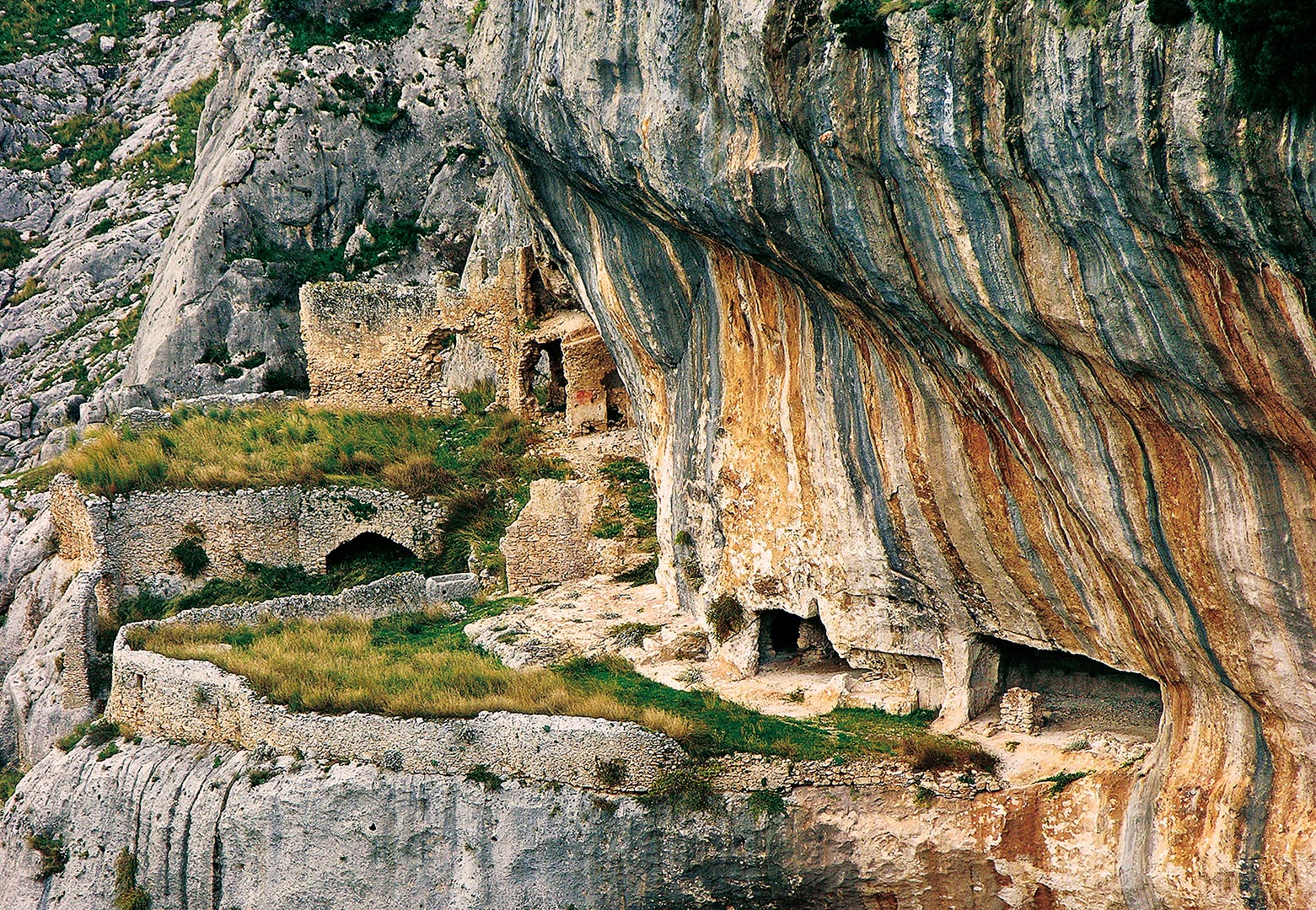
In the surroundings of Pulsano Abbey, perched in the wild folds of the Gargano, hides a silent and remote world of caves, stairways and paths climbing steep walls. These are the hermitages, ancient cells of solitude and contemplation, located in inaccessible places. Some are reduced to simple caverns in the rock, others appear as small isolated constructions perched on vertiginous cliffs, like sentinels of silence.
The hermits who lived there were in constant communication. Some hermitages were intended for communal life, shared prayer and collective work. Between the hermitages was a network of paths, stairways and canals carved by hand into the living stone. A veritable water network conveyed water to cisterns, terraces and cells. It was a hidden, decentralized but cohesive village.
Hermitage of St. Gregory
It is probably the oldest of the hermitages on the Pulsano hill. A large natural cavity of about 200 square meters, it has been dedicated since earliest times to St. Gregory the Great, the monk pope who contributed so much to the spread of monasticism in this land as well. The L-shaped cave narrows into a small ravine: a cozy corner that could serve as a presbyterial area, where mass was celebrated. This place is not only rock and silence: it is a living memory of a very ancient spirituality, still palpable within its walls.
Hermitage of St. Michael
Closer to the present abbey complex, this hermitage is reached from the small square in front of the church. It consists of three rooms carved directly into the rock, which served as cells for the hermits, and a masonry chapel, located on the edge of a breathtaking cliff. Only the side walls remain of the chapel today, but the cells house a true masterpiece of ingenuity: a network of tiny channels carved into the stone, created to collect and channel rainwater. A simple but effective system, evidence of ancient knowledge, attentive to nature and its resources.
According to some chroniclers, such as Ughelli and Cardinal Baronio, this hermitage hosted two extraordinary figures of Christianity: St. Francis of Assisi, who is said to have stayed there in 1216, and Celestine V, the hermit pope, who is said to have found refuge here in 1295 before fleeing to Vieste, where he was later arrested by Angevin soldiers. Two men, two stories, linked by a common thread: the desire for silence, for elevation, for God.