
Raffaele Perna, a native of Monte Sant’Angelo who died in Bari in 1983, was a teacher of Latin and Greek and a prominent figure in the cultural and educational life of Apulia in the 20th century. His career was marked by a strong commitment to teaching, which he viewed not merely as the transmission of knowledge but as a means of shaping students. The memorial in Monte Sant’Angelo honors him for his expertise in classical studies, his personal modesty, and his dedication to education.
Teaching as a Vocation: Perna remained dedicated to teaching for most of his life. According to accounts preserved in local memory, he turned down administrative positions—such as those of high school principal and superintendent of schools—in order to continue teaching. His career unfolded primarily at the “Quinto Orazio Flacco” classical high school in Bari, where he continued teaching until his retirement. His decision to prioritize teaching over administrative roles is one of the most defining aspects of his public persona.
The Years of Fascism and the War Perna’s biography also includes a civic and political dimension linked to the years of Fascism and World War II. Local accounts recall the hardships and pressures he faced during the regime and his subsequent return to Monte Sant’Angelo during the war. Documents from Bari in 1943 also list Perna among the professors who, after the fall of Fascism, worked to secure the release of people imprisoned for political reasons. These episodes place his activities within the broader context of civic engagement by Apulia’s intellectual and academic community.
Monte Sant’Angelo During the War During the war, Perna returned to Monte Sant’Angelo, where he also worked to ensure that displaced families who had found refuge in the town could continue their education. His efforts were part of the broader context of the challenges faced by local communities during the conflict and illustrate the role the school played as a social anchor as well as an educational institution.
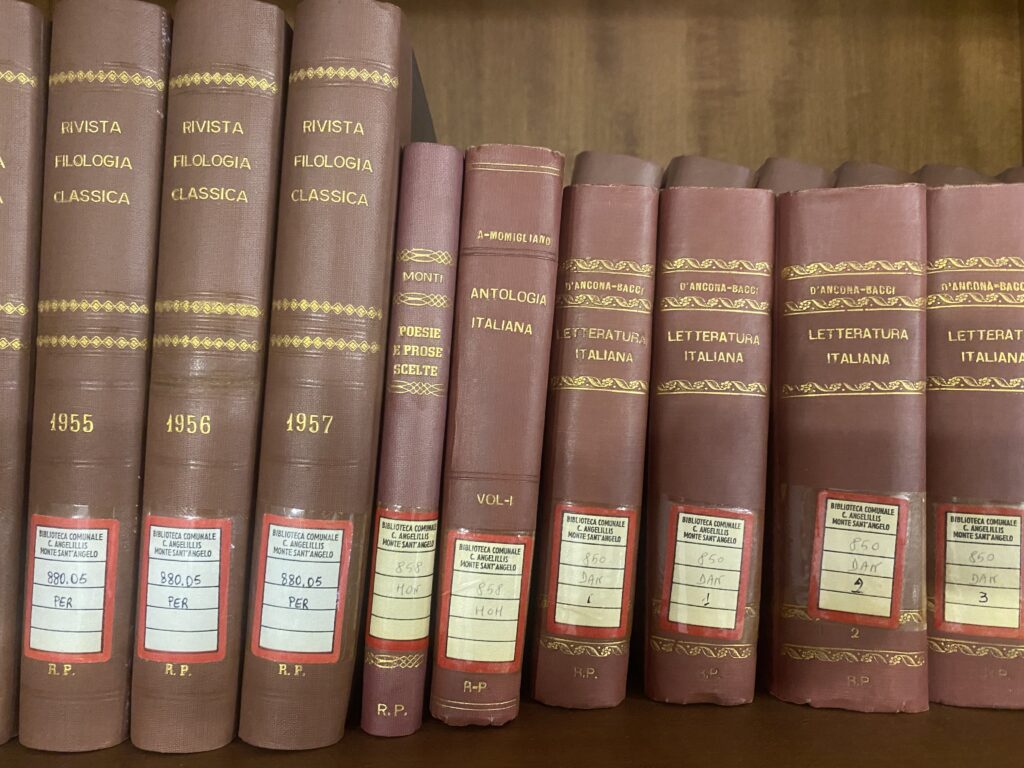
His Personal Library His work as a teacher and scholar is linked to his personal library, which is now housed at the “Ciro Angelillis” Municipal Library. The Raffaele Perna Collection is a specialized collection focused primarily on classical and humanistic studies, reflecting the interests he developed throughout his education and teaching career. The core of the collection includes works of Greek and Latin literature, philosophical texts, linguistic and philological studies, and publications on Italian literature.
Greek and Latin Classics: A substantial portion of the collection consists of works by classical authors. It includes texts and studies dedicated, among others, to Thucydides, Herodotus, Plato, Horace, Virgil, and Sallust. The inclusion of critical editions, annotated editions, and editions intended for use in schools and universities reflects the central role Perna attributed to the classical tradition in a humanities education. The collection also highlights the importance he placed on the direct study of ancient authors as part of his experience as a teacher of Latin and Greek.
Philosophy and the Humanistic Tradition: In addition to classical texts, the collection includes works of philosophy and anthologies dedicated to the “Classics of Philosophy.” The inclusion of Plato and other philosophical authors broadens the library’s scope beyond linguistic and literary studies, reflecting an interest in the history of ideas and the relationships between literature, philosophy, and the humanities.
Italian Literature The collection also includes a substantial section dedicated to Italian literature, featuring works by authors from different eras. Dante, Alfieri, Leopardi, and Carducci are represented, along with 20th-century authors such as Luigi Pirandello, Grazia Deledda, Giovanni Verga, and Riccardo Bacchelli. This collection allows readers to view Perna’s classical studies in the context of the Italian literary tradition, demonstrating the breadth of his cultural horizons.
Tools for Philological Research The collection also includes resources for study and teaching: dictionaries, lists of Latin abbreviations, philology and linguistics textbooks, and specialized publications. There are also journals dedicated to classical studies, including the *Rivista di Filologia Classica*. These materials attest to the importance Perna placed on the resources necessary for reading, interpreting, and teaching ancient texts.
Apulia in the Reading of the Classics Among Perna’s works is *Ricordi di Puglia in Orazio*, published in the 1960s. The book reflects his focus on the relationship between classical culture and the Apulian region and exemplifies his interest in the presence of the memory of ancient Apulia in Latin literature. The title is also significant for understanding how Perna linked the heritage of classical antiquity to regional culture.
A library built for teaching and study. The composition of the collection reveals a close relationship between its scholarly dimension and its educational function. Editions of the classics, commentaries, textbooks, dictionaries, and specialized journals are, in fact, complementary tools designed for reading and in-depth study of the texts. The simultaneous presence of specialized works and broader literary collections paints a picture of a personal library used for both research and daily teaching activities.
The Cultural Value of the Perna Collection The Raffaele Perna Historical Collection stands today as a significant testament to the humanistic culture and the Italian educational system of the 20th century. The collection allows us to trace the interests of a teacher deeply rooted in classical studies and, through his books, to observe the cultural pathways linking Greek and Latin traditions, philosophy, Italian literature, and the tools of philology. Its value therefore lies not only in the individual volumes but in the opportunity to reconstruct, through the library, a part of the intellectual and educational history of contemporary Puglia.
The Raffaele Perna Collection, now housed at the “Ciro Angelillis” Municipal Library, constitutes one of the library’s specialized bibliographic collections and, together with the Tancredi and Fischetti collections, helps document the diversity of cultural interests that developed in Monte Sant’Angelo during the 20th century. Its particular focus on classical studies gives the collection a well-defined identity and offers scholars concrete evidence of the central role of humanistic education in Italian academic culture during the last century.
Bibliography
Perna, R. (1960), *Ricordi di Puglia in Orazio*, Bari: Edizioni Levante. A 1963 edition published by Edizioni del Centro Librario is also known to exist.
“Ciro Angelillis” Municipal Library of Monte Sant’Angelo (n.d.), Historical Collections – Raffaele Perna Collection, Monte Sant’Angelo.
Apulian Institute for the History of Anti-Fascism and Contemporary Italy (n.d.), Bari, July 28, 1943, historical documentation containing references to Raffaele Perna’s statements in July 1943.
“Voice of the Community” (2012), “A Well-Deserved Tribute,” Monte Sant’Angelo, a commemorative tribute dedicated to Raffaele Perna.
“Pubblico esercizio” (2014), “80 Years of Orazio Flacco,” a chronicle of the history of the “Quinto Orazio Flacco” high school in Bari and its teachers.