
“The Angel in the Cave,” written in Monte Sant’Angelo on April 1, 1934, and published that same year in the *Gazzetta del Popolo*, is part of the “Le Puglie” section of *Il deserto e dopo*, a volume of travel prose and essays published by Mondadori in 1961. The text draws on Ungaretti’s experience traveling through the Capitanata region and gradually takes on a form that goes beyond a simple description of the places. The landscape, the monuments, and the pilgrimage become opportunities for reflection on memory, the human condition, and the possibility of transforming sensory experience into knowledge and poetry.
Monte Sant’Angelo and the Landscape of Rebirth The approach to Monte Sant’Angelo winds through a landscape dominated by the Tavoliere, wheat fields, and flocks of sheep. Spring and Easter form the symbolic backdrop against which the poet interprets the land as a space of regeneration. From the very beginning of the prose, light, warmth, and freshness are associated with rebirth, while the Apulian landscape is elevated beyond the purely descriptive and transformed into a spiritual experience. The images of the “resurrected” earth and the light of Easter thus introduce the theme of resurrection, which will reappear during the visit to the monument and the sanctuary.
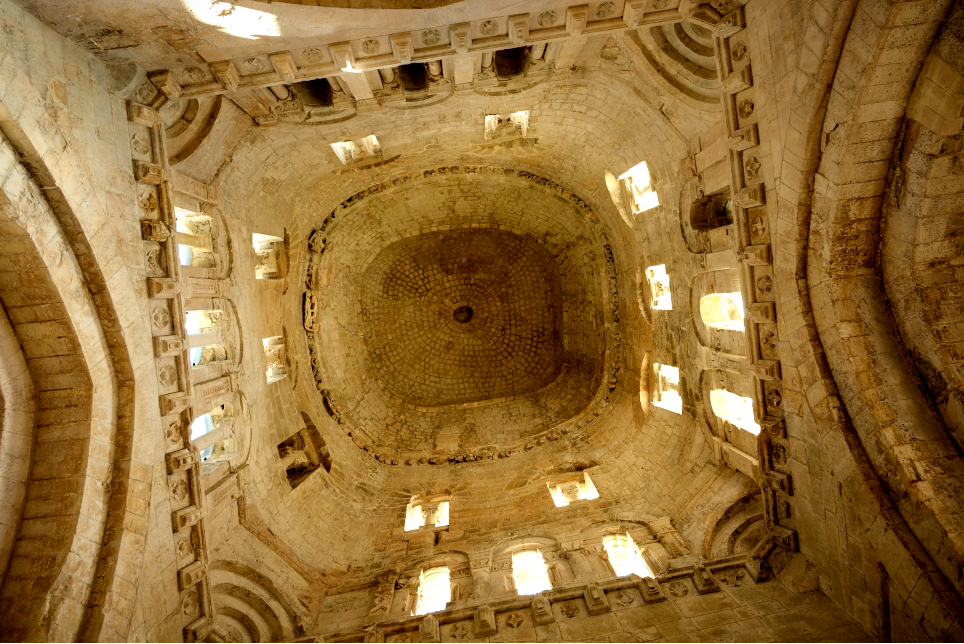
Rotari’s Tomb: Descent and Ascent The centerpiece of the experience is a visit to the so-called Tomb of Rotari, the Baptistery of San Giovanni in Tumba. Ungaretti immediately perceives its architectural uniqueness and evocative power: the interior, with its “dry pink” hue that gradually transforms into an increasingly intense light as it rises upward, gives the poet the impression of having descended “into the depths of a tomb.” The physical descent into the architectural space, however, transforms into a movement in the opposite direction: the gaze rises upward and encounters “motherhood” and “triumphant life.” The monument’s structure thus becomes, in the poet’s perception, a journey from dark depths toward the light.
Death, Baptism, and Rebirth The reflection then focuses on the building’s possible role as a baptistery: “Most likely, this tomb will also serve as a baptistery.” Ungaretti interprets baptism through a symbolic logic of death and resurrection: to die to the material world is to be reborn in the spirit. The upward movement of the architecture is thus translated into a metaphor for liberation from the burden of the material world and the attainment of grace. It is at this point that the expression “A rhythmic happiness counts, a divine precision counts” appears, in which the perception of space, spirituality, and the rhythm of the word merge.
The “rhythmic joy” of prose: This formula takes on particular significance in light of Glauco Cambon’s critical reflection on Ungaretti’s travel prose. Cambon emphasizes, in fact, that Ungaretti’s prose is not limited to description or logical exposition, but “embodies” the narrator’s experience and follows its inner movement. In the case of Monte Sant’Angelo, the very structure of the narrative reproduces this movement: observation of the landscape, entry into the monument, descent into the depths, the gaze rising again, the appearance of the angel, and finally reemergence into memory. The notion of “rhythmic happiness” must therefore be understood first and foremost in relation to Ungaretti’s own formulation and, on a critical level, to Cambon’s interpretation of the particular musicality and tension of his prose.
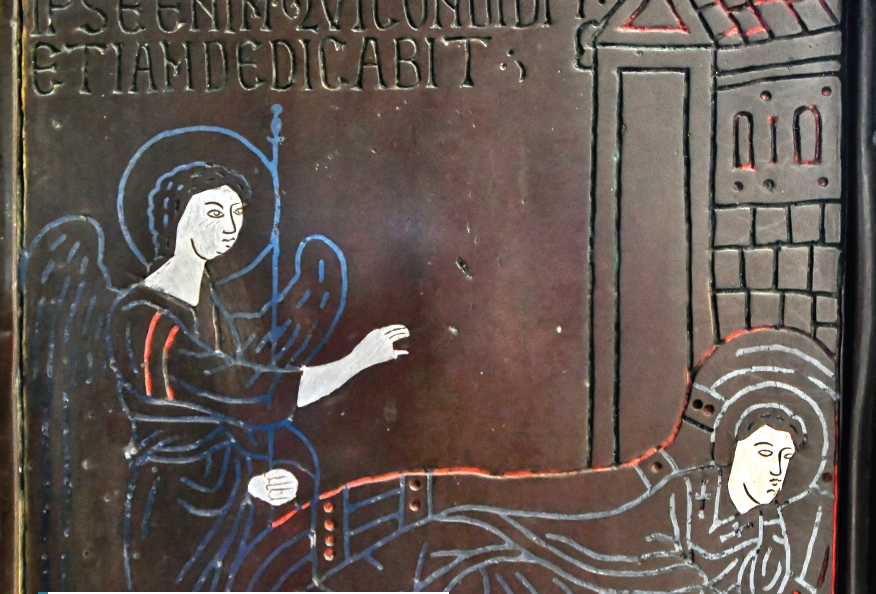
From Matter to the Apparition of the Angel: Having left the Tomb of Rotari, Ungaretti’s journey continues toward the Shrine of St. Michael. Here, the landscape and architecture are once again transfigured through a mythical and religious memory. “One day, an idea”—writes the poet—“which contained within itself many other forms fused together,” until it identified itself with Saint Michael the Archangel and settled upon the mountain. The image of the sanctuary allows Ungaretti to reconstruct a symbolic genealogy of the angel: “They say the angel first appeared to man, wielding a sword of sunlight that closed off Eden to us.” The angel thus becomes a figure of separation from Eden but also a guide for man in his wanderings.
The Angel, Memory, and Myth Angels are depicted as “stars, unattainable beacons that guided wandering footsteps through the desert.” This image directly links the sanctuary in the Gargano to the broader human experience of travel and being lost. The desert is not merely a geographical location: it is a condition of existence, a space in which humankind seeks direction through signs that precede and transcend it. The journey to San Michele thus becomes a pilgrimage through the memory of civilization and, at the same time, through one’s own inner self.
The “Bronze Door” and the Return to Origins Of particular significance is the reflection on the art of the sanctuary’s bronze door, which Ungaretti describes as having reached a state of “senile forgetfulness that heralds primitivism.” This phrase links old age with origin, the loss of memory with the possibility of a new beginning. The experience of the ancient, therefore, does not amount to mere archaeological contemplation: rather, art allows us to return to an original state in which words can once again be spoken in their most elementary and authentic form. It is precisely in this light that the reference to *Nelle vene* can be understood: “To spell out the naive words.” The line comes from the poem *Nelle vene*, included in the 1947 collection *Il Dolore *.
Art, Childhood, and Primitivism The idea of a return to the origins runs through his entire prose. Faced with the images of the sanctuary, Ungaretti interprets “primitivism” not as backwardness, but as the ability to recover an original perception of the world, prior to the accumulation of memory and conventions. The ancient monument thus becomes an instrument of knowledge: looking at art means rediscovering a primal form of wonder and speech. Ossola’s critical reading has linked this “senile forgetfulness” to a state of “before memory,” in which the return to the origin makes possible a rebirth of poetic language.
The Angel and the “Ghosts” of the Mind The following reflection explicitly introduces the theme of the ghost. Ungaretti writes that the ghost is “the finite image of a torment that may well be eternal,” and from there he goes on to explore the relationship between art, memory, and permanence. Through poetic works, humans attempt to lift their own experiences out of the precariousness of individual existence. Poetry thus becomes a form of permanence: what belongs to a specific place and time can continue to live on beyond the life of the one who experienced it.
Petrarch and the “memory of oblivion” The journey concludes with an explicit reference to Petrarch. Ungaretti describes the evening as “a moment of Petrarchan tone” and quotes “My ship, laden with oblivion, passes by,” the opening line of Sonnet 189 from the *Canzoniere*. Immediately afterward, he evokes “And the light has remained in my thoughts,” taken from Sonnet 18. The two fragments belong to different parts of the *Canzoniere*, but Ungaretti brings them together through their shared connection between light, memory, and oblivion. Light is not merely a visual element: it is what remains in memory once the experience has passed.
Prose as a Pilgrimage of Memory: The journey to Monte Sant’Angelo thus concludes with a gradual transformation of the landscape’s meaning. The road leads to the monument; the monument leads to reflection; reflection leads to memory; memory leads to poetry. The cave, the angel, the light, the ghost, and oblivion are the images through which Ungaretti constructs a true poetic experience of the place. The geographical pilgrimage becomes a pilgrimage into the memory of civilization and into the author’s inner world, following a dynamic in which descent and ascent, death and rebirth, oblivion and memory continually echo one another.
A Poetic Phenomenology of the Sacred: “The Angel in the Cave” can therefore be read as one of the most significant prose works from Ungaretti’s journey through Puglia. Rather than merely recounting his visit to the Tomb of Rotari and the Shrine of San Michele, the text transforms the monument into a symbol of human experience. The cave becomes the place of descent and rebirth, the angel the figure of guidance and revelation, light the sign of memory, and the word the means through which what has passed can return to the present. From this perspective, the journey is not merely a movement through space, but a quest for the origin and enduring nature of poetry.
Bibliography
Cambon, G. (1976), The Poetry of Ungaretti, Turin, Einaudi, “Piccola Biblioteca Einaudi,” 265.
Montefoschi, P. (a cura di) (2000), Giuseppe Ungaretti, *The Life of a Man: Travels and Lessons* , Milan, Mondadori, “I Meridiani.” This edition includes *Il deserto e dopo* and *Notes and Information on the Travel Prose Texts *.
Ossola, C. (1975), “‘In sogno e dal vero’: le prose,” in Giuseppe Ungaretti, Milan, Mursia, p. 439.
Ungaretti, G. (1934), “Easter. San Michele del Gargano, April 1, 1934. ‘The Angel in the Cave’, ” *Gazzetta del Popolo*, April 1, 1934; later published in *Il deserto e dopo*, Milan, Mondadori, 1961.
Ungaretti, G. (1947), *Il dolore*, Milan, Mondadori, poem “Nelle vene.”
Petrarch, F., *Canzoniere*, Sonnet XVIII, “When I Turn Entirely in That Direction.”
Petrarch, F., *Canzoniere*, Sonnet CLXXXIX, “My ship, laden with oblivion, sails on.”
Paglia, L. (ca. 2020), “Ungaretti’s Daunia” / “Giuseppe Ungaretti’s Daunian Prose,” for an analysis of the Apulian prose works and their sources and rewritings.