
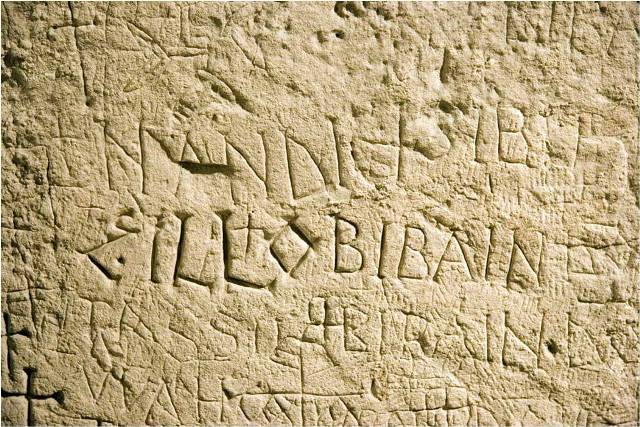
Longobard crypts
The Lombard crypts constitute the primary archaeological core of the Micaelic shrine complex, identified through systematic excavation campaigns conducted by Archdeacon Nicola Quitadamo (1949-1955). The stratigraphy highlights the final abandonment of these structures in the second half of the 13th century, when Angevin reorganization entailed the construction of the new “downhill” layout with consequent obliteration of the pre-existing structures under the medieval floor level.
The architectural layout consists of a 60-meter hypogeal gallery divided into eight rectangular barrel-vaulted bays with transverse arches on projecting pillars. The construction typology shows typically Lombard masonry techniques, while the side appendages serve as mortuary cells, respecting the cultic prohibition of direct burial in the locus angelicus.
The epigraphic corpus (6th-9th centuries) includes 200 inscriptions with differentiated engraving techniques, documenting international pilgrimage flows along the Via Francigena. Onomastic analysis reveals 97 Germanic anthroponyms on a predominantly Semitic-Latin basis, while the runic inscriptions represent one of the most significant early medieval epigraphic records in the Mediterranean area.
The Lapidary Museum
The Lapidary Museum, rearranged in 2015 according to scientific museographic criteria, preserves 200 sculptural artifacts from the Sanctuary’s stratified archaeological contexts and from city monuments: the former church of San Pietro, the Baptistery of San Giovanni in Tumba, the Abbey of Santa Maria di Pulsano, and the Celestinian monastic complex.
The lapidary material presents a chronology from the 11th to the 15th century, with architectural-decorative elements of Byzantine-Longobard tradition: capitals, columns, interlaced ribbon decorations. From the church of St. Peter: praying figure and headless Madonna (12th century), evidence of Apulian Romanesque sculpture. From the Cistercian abbey of Pulsano: paschal candle base and lustral fountain with biblical iconography (12th century).
From the shrine: micaelic statue (14th-15th century), Madonna and Child (15th century), lintel with angel and phytomorphic girals (mid-11th century). Outstanding ambo by sculptor Acceptus (11th century) with eagle-beam, capitals and carved beams, a paradigm of local Romanesque artistic production.
The adjacent Lombard room, tripartite by round arches, preserves the pre-Longobard “gate of Peter and Paul” with dedicatory epigraph. The bifid access system (curvilinear and rectilinear “winding” staircase) regulates pilgrim flows, while the “footprint” altar maintains the tradition of angelic vestiges. The fresco of the Custos Ecclesiae (11th century), found in situ protected by stone slabs, is currently musealized.
The Devotional Museum: faith, art and memory
The Devotional Museum, rearranged in 2008 with a double circular route, holds the Basilica’s Treasury: votive offerings, liturgical vestments, silverware and sacred furnishings, donations from popes, emperors and kings that survived the French looting of 1799. Among the most valuable pieces: the 14th-century Rock Crystal Cross Reliquary, the Savoy’s gilded vestments with Crusader shields (Basilica Palatina until 1929), and the 11th-century gilded copper Icon-the first depiction of the Archangel in the Sanctuary, donated by the Franks Robert and Balduino. The statues of the Sammecalére, a dynasty of local sculptors who were granted the exclusive privilege of production by Ferdinand I of Aragon in 1475, are significant. The Custos Ecclesiae fresco from the Lombard crypts depicts Leo the episcop, perhaps the archbishop of Siponto or Pope Leo IX. The museum brings together a unique heritage that tells the story of the shrine through votive offerings, liturgical objects, sacred vestments, icons and works of art. In it one encounters gifts from popes and emperors, but also simple testimonies of popular faith. Votive tablets, often painted by local artists, recount miraculous episodes related to the Archangel’s intervention, while precious liturgical silverware and sacred textiles speak of the richness and sacredness attributed to the place.