
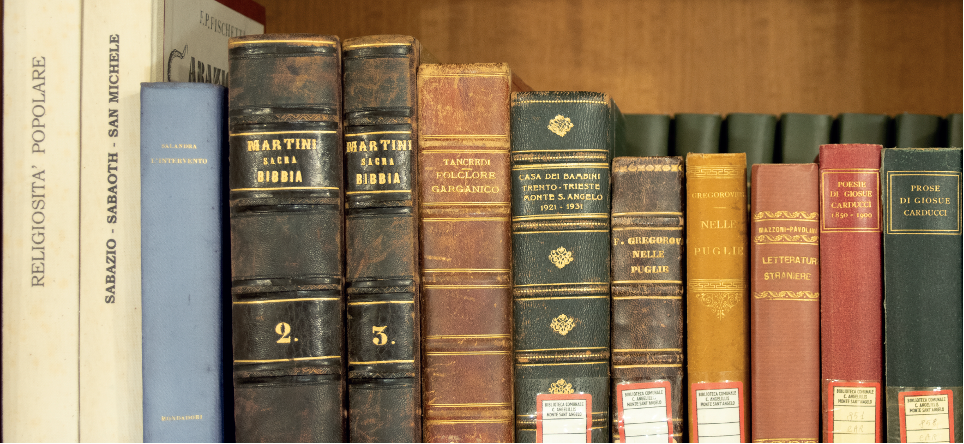
Giovanni Tancredi (1872–1948) was one of the most significant figures in the cultural life of Monte Sant’Angelo from the late 19th century through the first half of the 20th century. An educator, scholar, and enthusiast of folk culture, he devoted much of his work to collecting and promoting the traditions of the Gargano region, with a particular focus on the social and cultural reality of his hometown. His work unfolded against the backdrop of a growing interest in folk traditions, material culture, and local identities that characterized Italian scholarship between the 19th and 20th centuries.
Field Research Tancredi built his research work by collecting testimonies, documents, images, objects, customs, and materials related to the daily life of the Gargano community. His interests encompassed both the intangible aspects of culture—stories, proverbs, beliefs, festivals, and ritual practices—and the tangible aspects related to work, clothing, tools, household objects, and artisanal activities. Photography played an important role in this documentation effort: the Tancredi Photo Archive preserves approximately seven hundred photographic plates taken primarily between 1893 and 1932, along with other images on film.
The Museum of Folk Arts and Traditions In 1925, Tancredi founded the Museum of Folk Arts and Traditions of the Gargano in Monte Sant’Angelo, with the aim of collecting and preserving objects and artifacts reflecting the local material culture. The initiative was part of his broader educational and cultural project and addressed the need to document a rural, pastoral society undergoing profound changes. The collection included work tools, furnishings, costumes, handcrafted items, household objects, and materials related to popular religious practices.
The Gargano Folklore In 1938, Tancredi published *Folklore of the Gargano*, his most ambitious work dedicated to the region’s folk culture. The volume compiles a wealth of information on the practices and traditions of Gargano society, addressing topics that include the life cycle, festivals, religious practices, beliefs, rituals, work, family customs, and other aspects of everyday culture. The work remains, even today, a source of great interest for the historical and ethnographic study of Monte Sant’Angelo and the Gargano region.
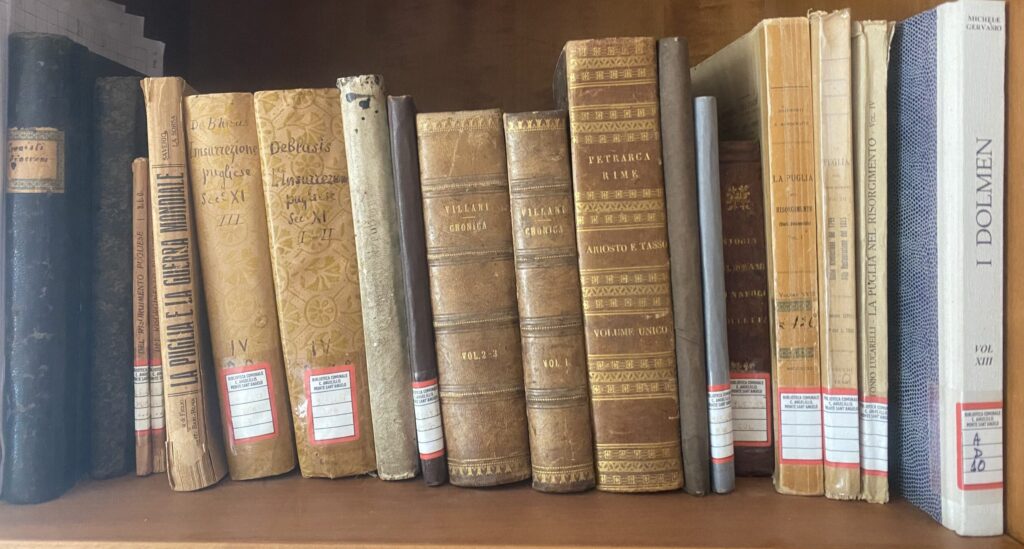
The Library’s Historical Collection The Giovanni Tancredi Historical Collection, housed at the “Ciro Angelillis” Municipal Library, reflects the breadth of the scholar’s interests and serves as an important record of the intellectual and cultural history of the Gargano region. The collection includes works on local history, archaeology, art, religion, linguistics, folk traditions, and the political history of Southern Italy. Its composition allows us to reconstruct not only Tancredi’s personal interests but also the bibliographic paths through which a local scholar built his body of knowledge.
Political and Religious History: A portion of the collection is dedicated to the history of the dynasties and institutions of Southern Italy. It includes works and documents relating to the Swabian and Bourbon periods, along with materials concerning the history of Monte Sant’Angelo and the Kingdom of Naples. This part of the collection reflects Tancredi’s interest in the political and dynastic events that contributed to the historical development of the region and complements his studies on the sanctuary and the cult of Saint Michael.
The Cult of Saint Michael and the History of the Region The religious dimension occupies an important place in Tancredi’s library. Among the materials preserved are studies dedicated to the cult of Saint Michael and the history of the sanctuary, alongside works relating to the monuments and religious traditions of Monte Sant’Angelo. Apollo and the Archangel Saint Michael also falls within this context, reflecting Tancredi’s interest in the continuity and transformation of the cultural and religious systems associated with the Gargano region.
Archaeology, Linguistics, and Folk Traditions The collection also includes publications on the archaeology of Apulia, Magna Graecia, dolmens, and toponymy, along with studies on language and folk traditions. Among other items, the collection includes materials on Apulian toponymy and the proceedings of conferences on folk traditions. This diversity underscores the interdisciplinary nature of Tancredi’s personal library, in which history, archaeology, linguistics, religion, and ethnography are used to interpret the region and its culture.
A Bibliographic Resource for Research: The value of the Tancredi Collection lies in its ability to connect the scholar’s works with the sources and studies that shaped his intellectual development. The collection makes it possible to reconstruct the local scholarly culture between the 19th and 20th centuries and, at the same time, to trace the evolution of scholarly interests focused on the Gargano region: from political and religious history to archaeology, from linguistics to the study of folk traditions. For this reason, the collection serves as a significant resource for research on the cultural and intellectual history of the region.
The Relationship Between the Library, the Museum, and Photographic Documentation The library collection gains further value when considered together with the Museum of Folk Arts and Traditions and the Tancredi Photo Archive. Books, photographs, and artifacts are, in fact, part of a single project to document Gargano society. Photography captures people, landscapes, festivals, crafts, pilgrimages, and customs; the museum preserves objects of material culture; and the library collects the books and research tools through which Tancredi interpreted the region.
Preserving the History of the Gargano. Overall, Tancredi’s legacy represents one of the most important records of the desire—which emerged in the first half of the 20th century—to document a Gargano society undergoing rapid transformation. Today, the bibliographic collection, together with the museum and photographic collections, allows us to view the Gargano not only through its monuments and religious history, but also through its work, customs, forms of social interaction, and expressions of popular culture.
The Tancredi Collection Today The Giovanni Tancredi Historical Collection thus constitutes a bibliographic heritage of particular interest for the study of the culture and history of Monte Sant’Angelo and the Gargano region. Its importance stems not only from the richness and variety of the works in the collection, but also from the opportunity to interpret them in relation to the scholar’s other writings. Together, the library, museum, and photo archive form a cohesive project dedicated to understanding and preserving local history, in which documentation of daily life holds equal value to historical and architectural research.
Bibliography
Tancredi, G. (1901), *On the Cliffs of the Gargano*, Ascoli Piceno, Tipografia Fiori.
Tancredi, G. (1910), A Short Dictionary of the Gargano Dialect, Monte Sant’Angelo.
Tancredi, G. (1938), Folklore of the Gargano, Manfredonia, Armillotta and Marino Printing Company.
Tancredi, G. (1938), The Bronze Door of the Royal Palatine Basilica of St. Michael in Monte Sant’Angelo (Gargano), Torremaggiore, V. Caputo Printing House.
Bronzini, G. B. (1989), “Sammecalére and Pilgrims at the Shrine of San Michele on the Gargano,” Lares, 55(1), pp. 5–41.
Trotta, M. (1982), Rural Society and Culture in the Proverbs of Monte Sant’Angelo, with an introduction by G. B. Bronzini, Foggia, Centro Studi Garganici, Remengraf.
“Ciro Angelillis” Municipal Library of Monte Sant’Angelo (n.d.), Historical Collections – Giovanni Tancredi Collection, Monte Sant’Angelo.
“Giovanni Tancredi” Ethnographic Museum (n.d.), Giovanni Tancredi – History and Timeline, Monte Sant’Angelo.