
Ferdinand Gregorovius (1821–1891), a German historian and author of the monumental *Geschichte der Stadt Rom im Mittelalter*, visited Puglia in the spring of 1874. He undertook the journey with his brother Julius and Raffaele Mariano, an Italian philosopher and historian with close ties to German cultural circles, who would later oversee the Italian translation of the account. Gregorovius visited Foggia, Manfredonia, and Monte Sant’Angelo in May, then continued on to other towns in Puglia. His experiences in Apulia would be incorporated into the fifth volume of *Wanderjahre in Italien*, titled *Apulische Landschaften* and published in Leipzig by F. A. Brockhaus in 1877.
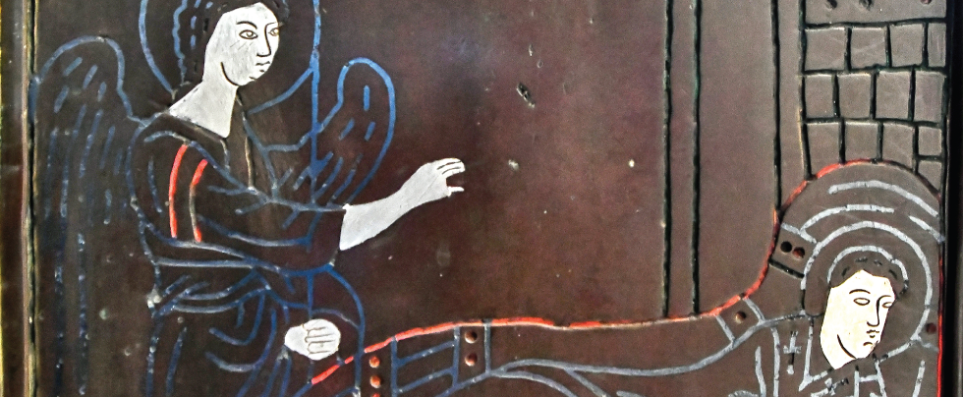
“The Archangel on Mount Gargano” The chapter dedicated to Monte Sant’Angelo bears the title *Der Erzengel auf dem Berge Garganus* in the original text. In the Italian version edited by Raffaele Mariano and published in 1882 under the title *Nelle Puglie*, the chapter becomes “The Archangel on the Gargano.” The title encapsulates the essence of Gregorovius’s experience: his encounter with the sanctuary dedicated to St. Michael and with a religious tradition that the historian considers one of the most significant phenomena in the history of Western Christianity.
Monte Sant’Angelo, “the metropolis of the cult of the Archangel”: Gregorovius describes the sanctuary in the Gargano as “the metropolis of the cult of Saint Michael in the West,” recognizing its exceptional position in European religious geography. This definition was later adopted by historiography on the cult of St. Michael and by Giorgio Otranto, who considers it particularly effective in summarizing the historical role played by the sanctuary. In fact, Gregorovius presents the Gargano as a sort of “Hagion Oros of the West,” a sacred mountain toward which pilgrims from different regions have been converging for centuries.
“The Angel Between East and West ” by Gregorovius opens the chapter by tracing the spread of the cult of angels in Jewish and Christian traditions. Michael is presented as the prince of the angelic hosts and as a figure associated with protection and the struggle against the forces of evil. The narrative then moves from the East toward the West, ideally following the geographical spread of the cult of St. Michael. In his historical account, Gregorovius connects the sanctuary in the Gargano with other major sites dedicated to Saint Michael, all the way to Mont-Saint-Michel in Normandy, thereby creating a European geography of the Archangel.
The Legend of the Apparition on the Gargano After this scholarly introduction, Gregorovius explicitly presents the tradition concerning the Archangel’s apparition. The story recounts that a wealthy landowner named Gargano lived in Siponto, whose herds grazed on the promontory. The disappearance of a bull led Gargano and his shepherds to the entrance of a cave. His attempt to strike the animal with an arrow miraculously ended with the arrow returning to the one who had shot it. The incident was then reported to Lorenzo, the bishop of Siponto, who ordered three days of fasting. On the last day of penance, according to the account cited by Gregorovius, Michael appeared to the bishop and declared that he had personally consecrated the cave.
The account from 493 and the hagiographic tradition: Gregorovius records in his account that the first apparition took place on May 8, 493, and that the shrine was consecrated on September 29 of the same year. These dates belong to the hagiographic tradition of the apparitions and should not be understood as historically documented dates of the supernatural events described. The primary medieval text underlying this tradition is the *Liber de apparitione sancti Michaelis in Monte Gargano*, which transmitted the account of the apparition and contributed to the development of the sanctuary’s cultic memory. Gregorovius, as a nineteenth-century historian, does not, however, merely repeat the legend: he places it within the broader history of the spread of the cult of St. Michael.
The Bull, the Cave, and the Consecration of the Sacred Space The first episode of the legend takes on a foundational role in Gregorovius’s account. The bull found in front of the cave leads the protagonists to a space that, even before being transformed into a sanctuary, already appears marked by the presence of the Archangel. When Lorenzo enters the cave together with the Christians, he finds it transformed into a luminous and sacred space: the rock, the altar, and the heavenly light become the signs of divine consecration. The cave is therefore presented not merely as a natural site, but as a space in which nature and the manifestation of the sacred coincide.
The Sanctuary and the Memory of Antiquity One of the most interesting features of Gregorovius’s prose is his ability to superimpose Christian history onto the memory of classical antiquity. Before recounting the apparition, he notes that sanctuaries associated with figures such as Podalirius and Calchas were known on the Gargano in antiquity. In this way, the sanctuary dedicated to St. Michael is situated within the promontory’s longer sacred history: Christianity does not occupy a space devoid of memory, but takes root in a landscape that Gregorovius perceives as already deeply marked by cults, oracles, and places of pilgrimage.
The Continuity of Sacred Sites: The relationship between ancient cults and Christianity is one of the chapter’s most significant interpretive themes. Gregorovius describes Saint Michael as the one who takes the place of earlier deities and pagan cults, constructing a nineteenth-century interpretation of the Christianization of the landscape. This interpretation is rooted in the historical and comparative culture of the nineteenth century and must be distinguished from contemporary reconstructions of the Christianization of the Gargano. The value of this passage therefore also lies in its testimony to how a nineteenth-century European historian interpreted the relationship between pagan memory, Christian worship, and the sacred landscape.
Gregorovius the Pilgrim: The most significant part of the chapter stems from firsthand experience. After reconstructing the history of the cult, Gregorovius gradually moves away from the perspective of an outside historian and assumes that of a pilgrim. He writes, in fact, that he had long desired to visit Lucera, Manfredonia, and the Gargano, and that it was not until the spring of 1874 that he was able to fulfill his wish. The ascent of the mountain thus becomes an integral part of the narrative: the scholar who had reconstructed the history of the sanctuary through documents and books personally enters the space that, until then, he had known only through tradition.
The Cave and the Experience of the Sacred Entering the cave is the highlight of the visit. Gregorovius describes a scene dominated by dim light, candlelight, a multitude of pilgrims, and the figure of the Archangel. The staircase leading to the grotto, the pilgrims crowding together or praying on their knees, the illuminated altar, and the flickering movement of the light create an atmosphere that the historian describes as almost unreal. The visual experience is thus transformed into a spiritual and literary one, to the point where the sanctuary is perceived as a place suspended between reality and dream.
The City of Pilgrims Gregorovius also notes the collective dimension of worship. Monte Sant’Angelo does not appear simply as a monument, but as a city brought to life by the presence of pilgrims, devotional practices, and the ongoing journey to the grotto. The historian emphasizes that the sanctuary had retained an extraordinary power of attraction over the centuries and that pilgrims from various backgrounds continued to climb the mountain toward the same cave. For Gregorovius, the continuity of religious practice represents one of the most striking manifestations of the place’s historical endurance.
Monte Sant’Angelo in the European Geography of the Archangel: Gregorovius places the Gargano sanctuary within a European network of sites dedicated to St. Michael. By comparing it with Mont-Saint-Michel and other Western shrines, the historian constructs a geography of the Archangel that connects the Christian East, the Gargano, Rome, and Western Europe. Within this geography, Monte Sant’Angelo occupies a privileged position, not only because of the antiquity of its cult but also because of the continuity of pilgrimage and the sanctuary’s ability to preserve a direct connection between the mountain’s natural landscape and the memory of the apparition.
Modernity Confronted by an Ancient Site One of the most evocative aspects of the narrative arises from the contrast between nineteenth-century modernity and the enduring presence of the sanctuary. Gregorovius observes that over the centuries, empires, peoples, and languages have disappeared, while new continents have been discovered and Europe has been transformed by revolutions and inventions; the figure of the Archangel, however, remains unchanged in the memory of pilgrims. The sanctuary thus becomes, for the historian, a place where historical time seems to slow down and where the past continues to manifest itself through the repetition of devotional gestures.
A Convergence of History, Legend, and Travel “The Archangel on Mount Gargano” is the result of the convergence of three dimensions: the historian’s scholarship, hagiographic tradition, and the traveler’s personal experience. Gregorovius reconstructs the history of the cult, recounts the apparitions as they are described in tradition, and, at the same time, records what he witnessed firsthand in May 1874. The cave and the sanctuary thus become places where the past is continually brought to life by the presence of pilgrims and by the visitor’s own experience.
Bibliography
Gregorovius, F. (1877), *Wanderjahre in Italien*, Vol. V: *Apulische Landschaften*, Leipzig, F. A. Brockhaus. This volume includes the chapter “Der Erzengel auf dem Berge Garganus.”
Gregorovius, F. (1882), *In Puglia*, translated from the German by Raffaele Mariano with the translator’s travel notes, Florence, G. Barbera, 451 pp.
Gregorovius, F. (1975), *In Puglia*, a reprint of the 1882 Italian edition, Bologna. The reprint is listed in specialized bibliographic directories.
Gregorovius, F. (1997), *Wanderjahre in Italien*, published by C. H. Beck, Munich. For the German text of the chapter “Der Erzengel auf dem Berge Garganus.”
Otranto, G. (2008), “Il cammino dell’Angelo tra strade e santuari di Puglia”, in AA.VV., Rome–Jerusalem: Along the Francigena Routes of the South , Rome, pp. 82–94.
Campione, A., & Laghezza, G. (2023), “An Essay on the Cult of St. Michael and the Reception of the Gargano Shrine in Nineteenth-Century Travel Literature, ” *Nuovo Meridionalismo Studi*, IX, 16.
Treccani – Istituto della Enciclopedia Italiana, entry “Gregorovius, Ferdinand,” Dizionario Biografico degli Italiani. Particularly useful for the chronology of the 1874 trip to Apulia and for the genesis of *Apulische Landschaften*.
Regione Puglia, Apulia: Landscapes and Villages of Italy , a document on regional development that draws on Gregorovius’s definition of Monte Sant’Angelo.