
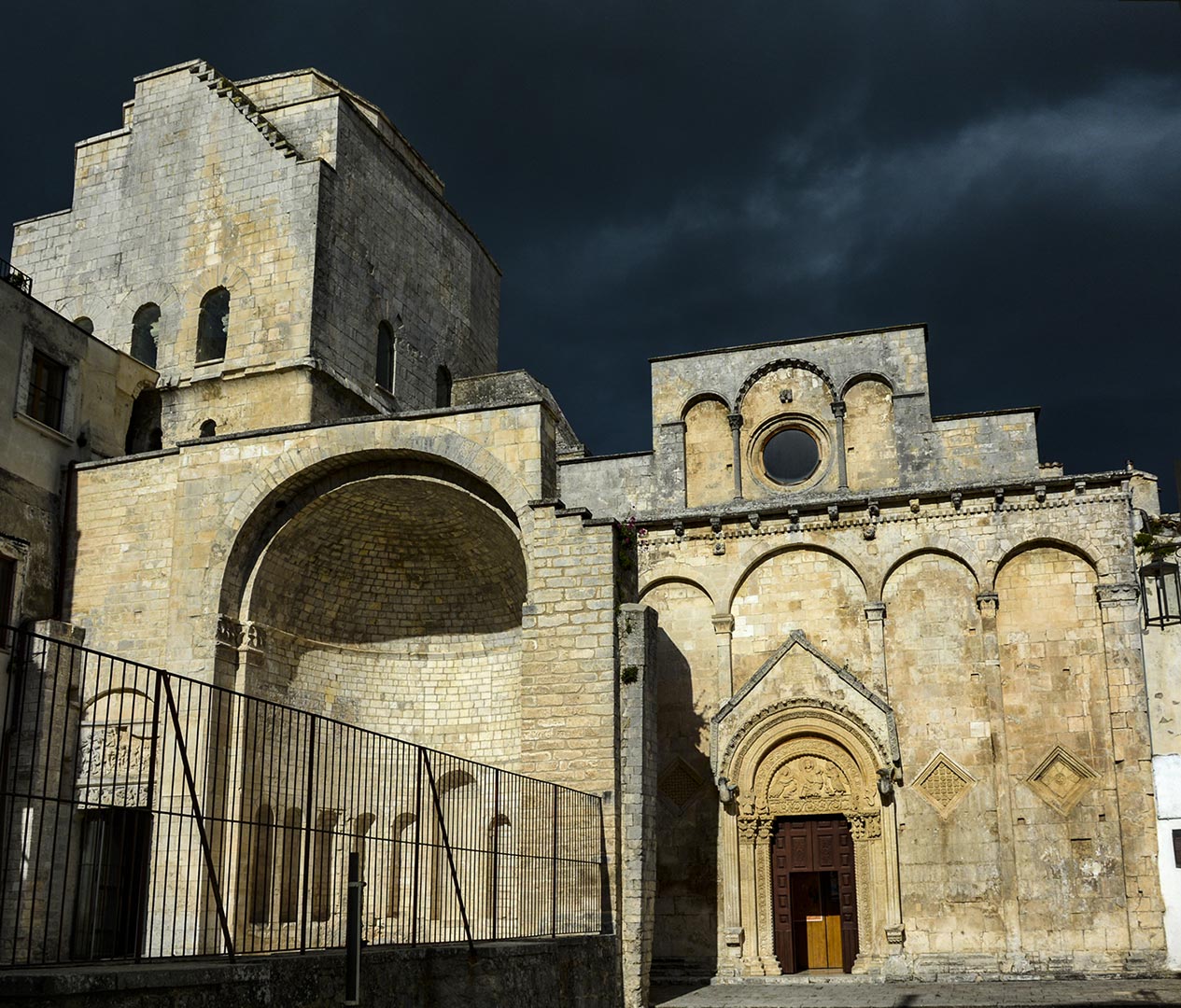
The church of Santa Maria Maggiore is located in the heart of the ancient religious center of Monte Sant’Angelo, a short distance from the sanctuary of San Michele, next to the remains of the church of San Pietro and the baptistery of San Giovanni in Tumba, traditionally known as the “Tomb of Rotari”. The complex is one of the main religious nuclei of the city and preserves a stratification that spans the Early Middle Ages, the Romanesque age and the transformations of the modern age. The Liber de apparitione already mentions, near the cave, a church dedicated to St. Peter with altars in honor of the Virgin and St. John the Baptist, while the Life of Bishop Lawrence, written in the eleventh century, speaks of three basilicas dedicated to the Virgin, the Baptist and the Prince of the Apostles.
Origins and stratification of the complex The foundation of Santa Maria Maggiore is traditionally linked to Archbishop Leo, who ruled the Sipontine see from 1023 to 1050. The church was built on a steeply sloping rocky terrain, already occupied by the cemetery area of San Pietro: during the restorations, thirteen tombs with coins dating back to between the eighth and ninth centuries came to light. Traces of the eleventh-century construction have been recognized in the base of an apse found under the current presbytery, in the soccorpo and in two pilasters of the counter-façade.
In the last decades of the twelfth century, the Gargano mountains experienced a season of great vitality: in 1177 William II assigned the Honor Montis Angeli as a dowry to his wife Joan of England, which since then became a fief of the queens. In this context, a radical reconstruction of the church began. An inscription walled into the tympanum of the portal recalls that on 10 June 1198, during the reign of Empress Constance with her son Frederick, Benedict II, priest and prelate of the church, began the new building in honour of God and the Virgin. According to the prevailing opinion today, the date indicates the start of the reconstruction of a pre-existing building and not necessarily the construction of the portal visible today, which belongs to a more advanced phase of the construction site. The new church is located at the meeting point between the Romanesque of Capitanata and the first experiences of the Swabian age.
The basilica layout and the roofs of Santa Maria Maggiore is a narrow hall with three naves, divided into three bays and marked by cruciform pillars. The central nave, without windows, preserves in the third bay a dome on pendentives from the Middle Ages, in whose drum an oculus closed by an Islamic-style barrier re-emerged during the restorations; the first two bays are covered by lunette barrel vaults, the result of renovations, and the side aisles by cross and sail vaults. The trapezoidal presbytery, which replaced the three original apses, dates back to the eighteenth century, like most of the current roofs.
The medieval reconstruction lowered the walking surface, accentuating the momentum of the pillars, and extended the hall towards the valley up to the limit allowed by the apse of St. Peter’s, defining the relationship between the two buildings still legible today.
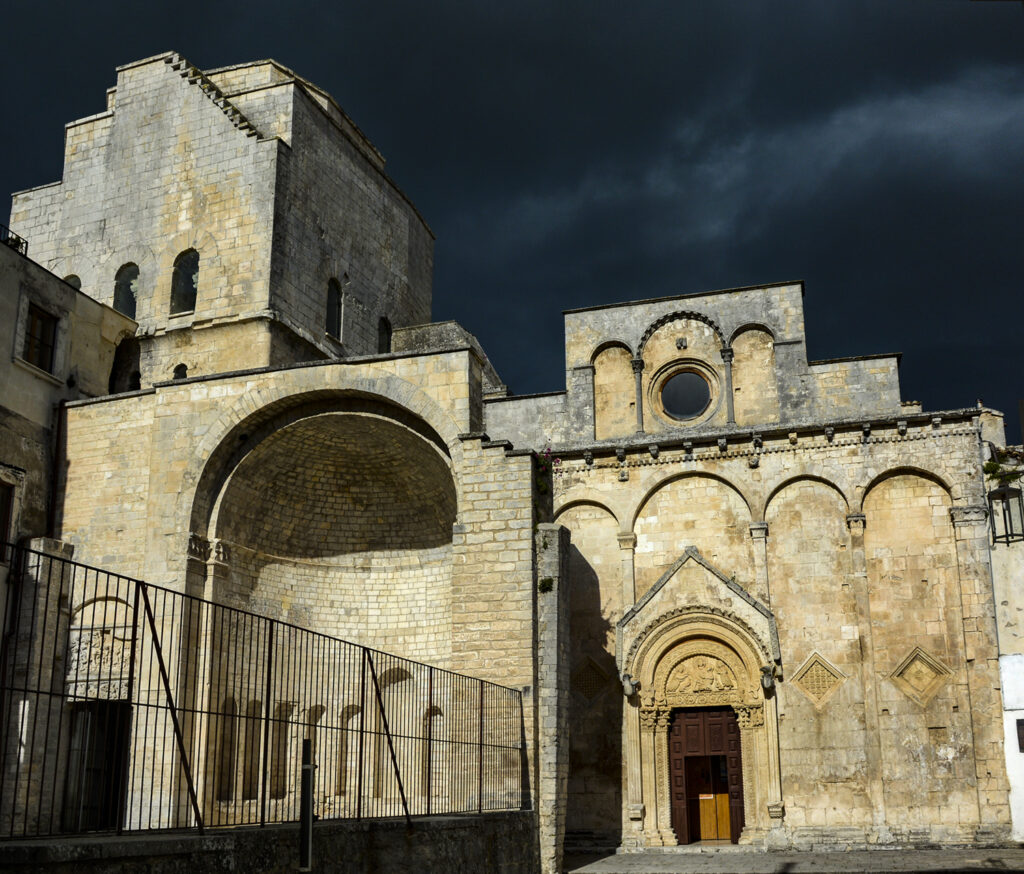
The Romanesque façade and the lozenges The façade, with two orders like those of the cathedrals of Troia, Foggia and Termoli, is marked in the lower part by five blind arches on pilasters, between which are inserted lozenges with the background adorned with floral and interlacing motifs. These elements, among the most characteristic of the Romanesque of Capitanata, find close comparisons in Santa Maria di Siponto and in the abbey of Santa Maria di Pulsano and also reveal ancestry of the Fatimid Islamic world. The upper part of the façade, small in size, is crossed by three blind arches on columns with crochet capitals, referable to the most advanced phase of the construction site.
On the side entrance, on the southern side, there is a relief with the Madonna and Child, a stone transposition of a Byzantine icon, coming from the lunette of the portal of the previous church.
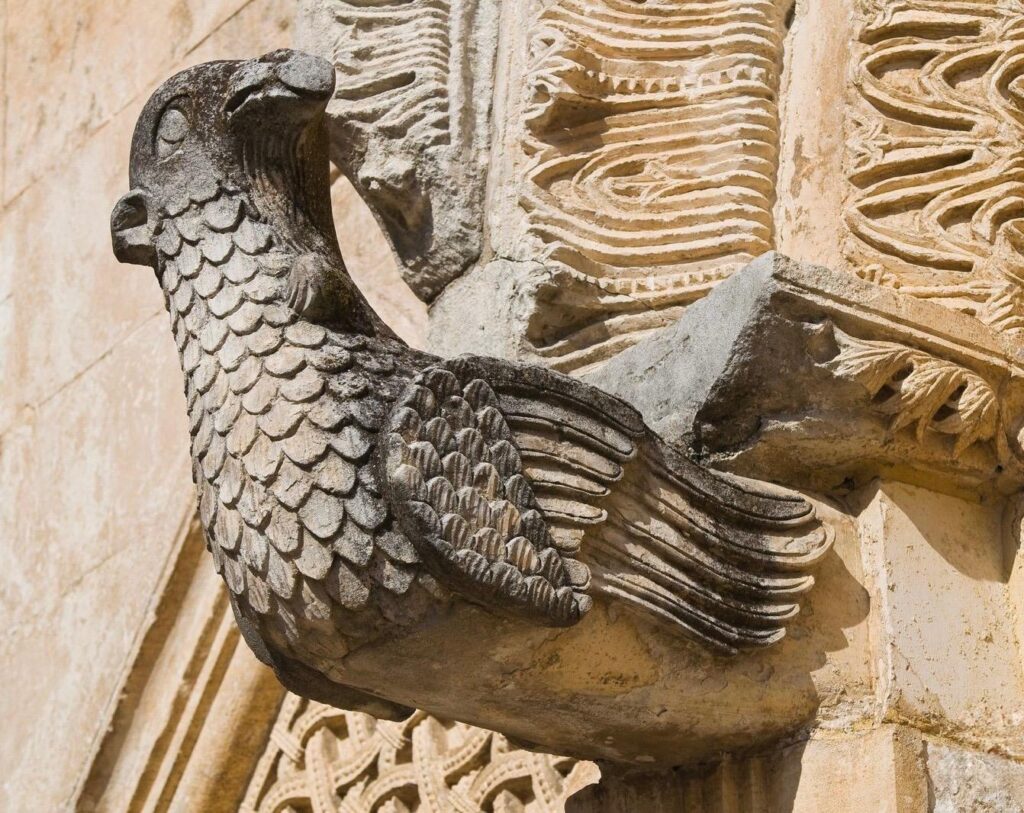
The portal and the patronage In the center of the façade is the rich late Romanesque portal, with a hanging porch resting on two griffins. In the lunette, the Virgin enthroned with the blessing Child, according to the Byzantine model of the Hodegetria, is flanked by two thurifer angels and the symbols of the evangelists; at the bottom are depicted two small kneeling figures in the act of prayer. Tradition identifies them with the Empress Constance and with the priest Benedict mentioned in the inscription; according to another reading, proposed by Maria Stella Calò Mariani, her son Frederick would be portrayed next to Constance when he was still a child.
Architrave, jambs and capitals are adorned with spirals that arise from the jaws of small dragons, from shoots of crumpled leaves and from animal protomes; on a capital of the right jamb there is a seated king, perhaps an image of the Ascension of Alexander the Great. The portal is one of the most important episodes of Romanesque sculpture in the Capitanata; some elements, such as the mutilated griffins and the jambs without decoration, suggest that it was remodeled in a later period.
Sculpture and artistic relations with the Capitanata and Abruzzo The sculptural apparatus reveals a dense network of relationships. The sculptures of the portal, the corbels of the cornice and the elements of the sloping walls find comparisons with Santa Maria and San Leonardo di Siponto, with San Clemente a Casauria in Abruzzo and with the former collegiate church of Foggia. Studies have highlighted the circulation of models and craftsmen between Capitanata and Abruzzo between the twelfth and thirteenth centuries, perhaps mediated by the nearby monastery of Pulsano, within a wider network that included western France, the Dalmatian coast and the workshops active in Jerusalem before the fall of the city in 1187.
Inside, the capitals of the pillars, with men assaulted by reptiles, heads spitting racemes, dragons and crochet leaves, refer instead to the construction sites of the age of Frederick II and find comparisons in the relief of the former collegiate church of Foggia; in the presbytery a capital depicts the months of the year. According to Calò Mariani, builders and carpenters already employed by the emperor in the castle also worked there, which a register of the forties of the thirteenth century recalls residents of Monte Sant’Angelo. The sculptures confirm that the construction site lasted until the third or fourth decade of the thirteenth century.
The altar of 1225 and the completion of the construction site The long duration of the work is also documented by an inscription, now preserved in the sacristy, which recalls the high altar, now lost, commissioned in 1225 by Luca, canon of the Gargano church (Ego Lucas Garganicae Ecclesiae Canonicus hoc altare fieri feci). Almost thirty years after the start of 1198, the construction site was therefore engaged in the creation of the furnishings and interior sculptures: the date constitutes a fixed point for the chronology of the different phases of the church.
Naval graffiti and the dimension of the pilgrimage Numerous graffiti are engraved on the surfaces of the church, inside and outside, which were already the subject of a first report at the end of the nineties. The study by Domenico Luciano Moretti (2018) has systematically analyzed for the first time those of naval subjects, identifying a concentration in the first three rows of the external wall. Some boats can be dated, due to their characteristics, to the twelfth century, when the façade must have been in forms close to the current ones; among them are medieval galleys, with oars and sail propulsion and large side oars used as rudders. The graffiti are an exceptional testimony of the material culture and presence of the sea in the history of Monte Sant’Angelo.
Graffiti as evidence of medieval devotion The original meaning of the engravings is not documented. Moretti proposes to read them as votive offerings left by sailors and pilgrims who, disembarking in the port of Siponto, went up to the sanctuary of San Michele to continue perhaps towards the Holy Land. The hypothesis is part of the framework of the maritime connections of the Adriatic and the great medieval devotional itineraries, but the votive character of the individual engravings remains an interpretative hypothesis.
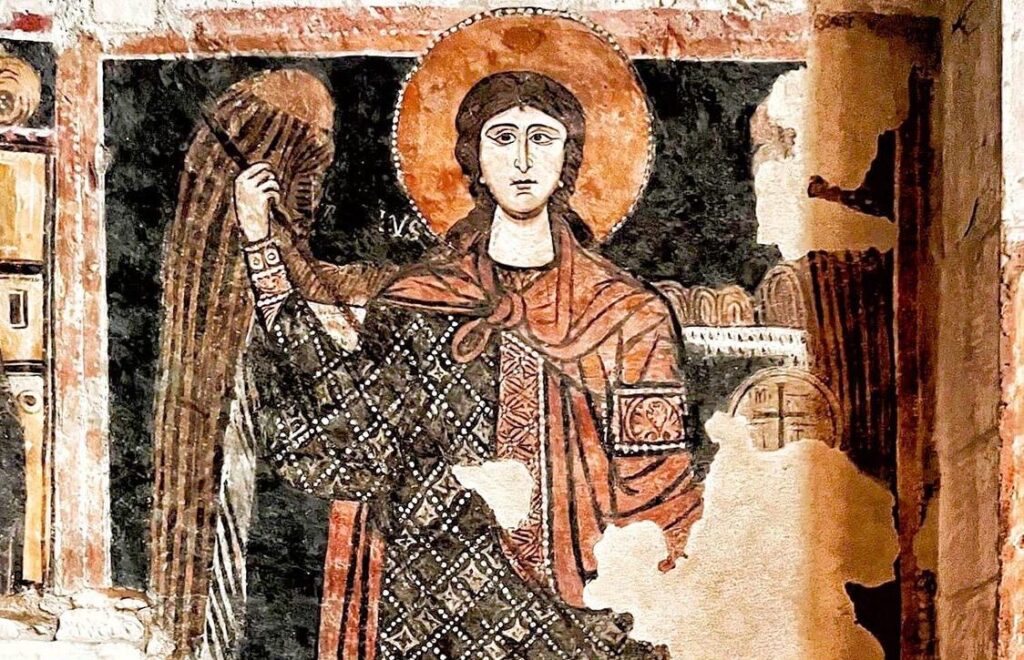
Medieval pictorial decoration During the restorations, the removal of the plaster brought to light on the walls and pillars a large pictorial decoration, spread in several layers between the thirteenth and fifteenth centuries. Among the oldest images are a monumental St. Michael in court clothes, in the act of piercing the dragon, and an Annunciation, from the Byzantine tradition and datable to the end of the thirteenth century. The cycle also includes a Madonna and Child Enthroned, bishop saints, St. Nicholas, St. Bartholomew, St. Leonard, St. Luke and two images of St. Francis, among the oldest in the region.
The presence of the saint of Assisi is linked to the tradition of his pilgrimage to the sanctuary, usually placed in 1216: the oldest Franciscan sources do not mention it and the first account of the episode dates back to the late fourteenth century. Of particular interest is the votive offering of a Templar knight, kneeling at the foot of a tower, painted on a pillar of the central nave towards the end of the thirteenth century. Alongside painters faithful to the Byzantine tradition, artists of Gothic culture worked, testifying to the variety of languages present in the Capitanata of the late Middle Ages.
The complex of San Pietro Santa Maria Maggiore should be read together with the remains of St. Peter and the baptistery of San Giovanni in Tumba. The church of San Pietro, transformed at the beginning of the seventeenth century by Archbishop Domenico Ginnasio, was demolished for static reasons in 1894: above all, the apse basin marked by eleven niches remains. The baptistery, improperly known as the “Tomb of Rotari” due to the misinterpretation of an epigraph, was built in its current form in the first decades of the twelfth century on the initiative of Pagano, a native of Parma, and Rodelgrimo, a native of the Gargano, remembered by an inscription. The three buildings form a unitary monumental system, marked by transformations, demolitions and reconstructions, whose religious attendance dates back to the Early Middle Ages.