
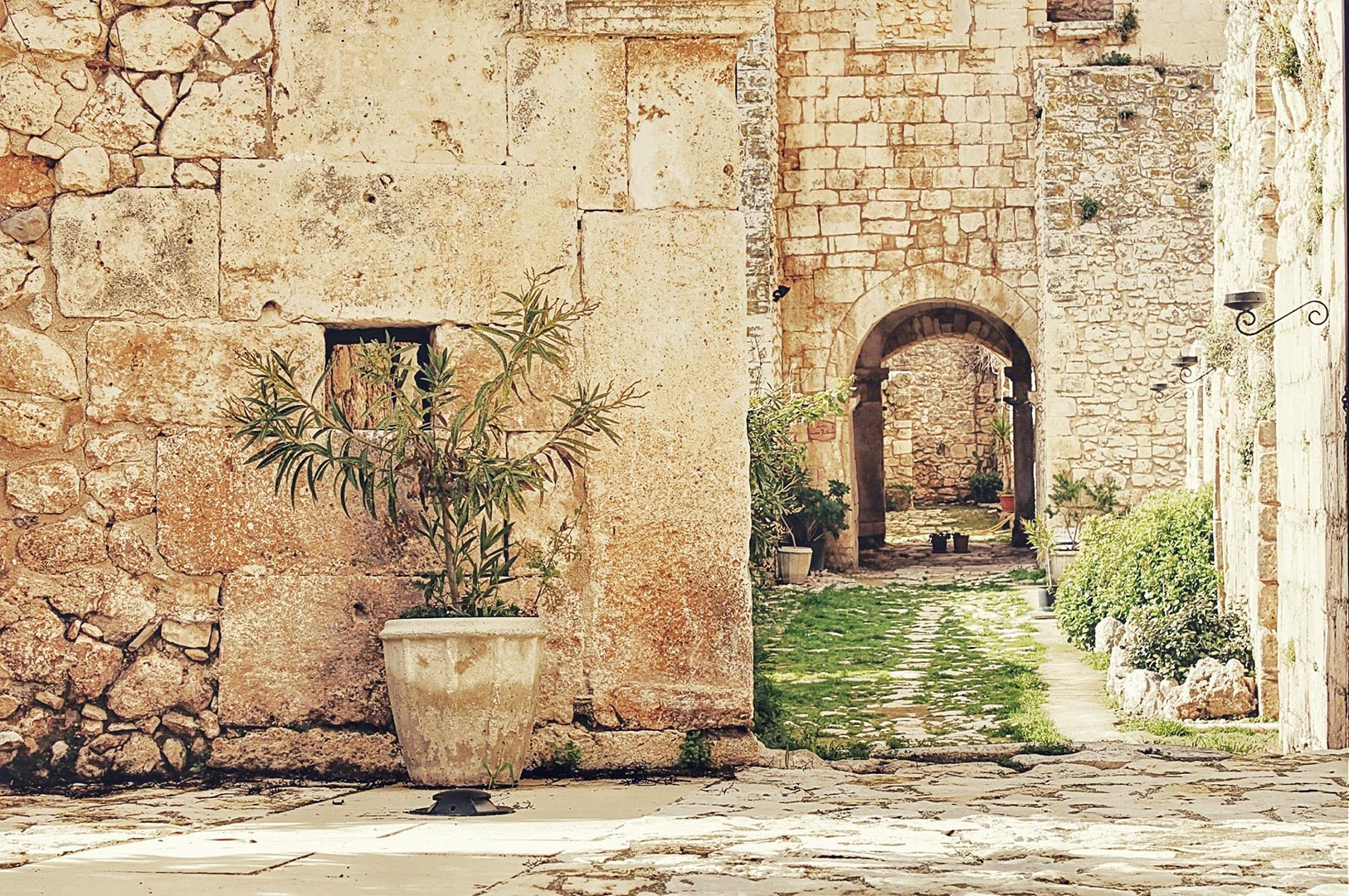
Pulsano Abbey

A shining example of monastic life, a destination for pilgrims and a place of study and prayer, the Abbey is located just a few kilometers from the town of Monte Sant’Angelo, overlooking the valley that pilgrims used to travel through to reach sacred destinations. The origins of the complex are shrouded in legend. The monastery was erected in the 6th century, and in the 10th century it passed to the Cluniac monks.

The true rebirth of the complex occurred in 1129 thanks to St. John of Matera, who founded there the Pulsanense Congregation, an autonomous monastic order inspired by the Benedictine rule but strongly influenced by Eastern hermitism. This order distinguished itself by its ascetic life and the spread of rock hermitages around the abbey, many of which can still be visited today. The church, enclosed within the powerful walls of the monastery, can be traced back to the work of Abbot Joel (1145-1177). The façade, rebuilt perhaps after the 1642 earthquake, which caused severe damage to the entire monastic complex, retains the original entrance portal, two windows and an oculus decorated with plant motifs.

Inside, the nave is punctuated by wide, high arches on the perimeter walls, with a large presbytery area; the longitudinal body occupies part of a large grotto. The nave, widening toward the N, laterally incorporates two small sections of the cave that house Abbot Jordan’s tomb.

The fragments from Pulsano, now housed in the Museo Lapideo, can be traced to Abruzzi craftsmen who worked for the abbey during the time of Abbot Joel. One of these is the lustral fountain, with its base consisting of four squatting zoomorphic figures interspersed with small columns decorated with precious capitals. Carved around the basin are ten zoomorphic and anthropomorphic protomes and water outlet holes. At the top four New Testament scenes and symbols of the evangelists.

Bibliography

  • Angelillis, C. (1956). Pulsano and the Pulsano monastic order. Historical Archives of Puglia, VI, 421-463.
  • Bertelli, G. (2003). S. Maria in Pulsano on the Gargano: a hypothesis for reading. In Proceedings of the 16th Conference on the Early Middle Ages (Spoleto-Benevento).
  • Calò Mariani, M. S. (1984; 1986). The art of the thirteenth century in Apulia. Turin-Rome.
  • Cavallini, A. (1999; 2001). Saint Mary of Pulsano. ..; The life of Saint John of Matera. Foggia-Manfredonia.
  • Cerasoli, M. (1953). The Benedictine congregation of Pulsan hermits. Quarry.
  • Favia, P., & Giuliani, R. (2011). The so-called hermitage of Santa Margherita…. In Proceedings II Conference… Vasanello.
  • Maulucci, F. P. (2001; 2011). The abbey of Santa Maria di Pulsano between history and archaeology. San Severo.
  • Muntoni, I. M., Rignanese, G., & Savino, G. (2015). Santa Maria di Pulsano–New data from the necropolis area. In Proceedings Conference Daunia.
  • Panarelli, F. (1997). From Gargano to Tuscany: Pulsan monasticism. Rome.
  • Wikipedia. (2025). Abbey of Santa Maria di Pulsano; John of Matera; Pulsano Abbey.
  • Sarnelli, P. (1680/1986). Cronologia de’ Vescovi et Arcivescovi Sipontini. Manfredonia/Bologna.
  • Institutional sites: abbeydipulsano.org, montesantangelo.info, fondoambiente.it (consulted 2025).

Tags :

Share :

Search our portal content

Through this search form you will be able to get immediate results on all the content within our web portal, such as pages, articles, news, digital library documents, archaeological finds, sacred vestments, votive tablets and much more.

Search for Books in the Library

Need to check for a specific content in our library? Use the form below which will take you back to the results for our library on the official page of the regional library system.


Search our portal content

Through this search form you will be able to get immediate results on all the content within our web portal, such as pages, articles, news, digital library documents, archaeological finds, sacred vestments, votive tablets and much more.

Search for Books in the Library

Need to check for a specific content in our library? Use the form below which will take you back to the results for our library on the official page of the regional library system.