
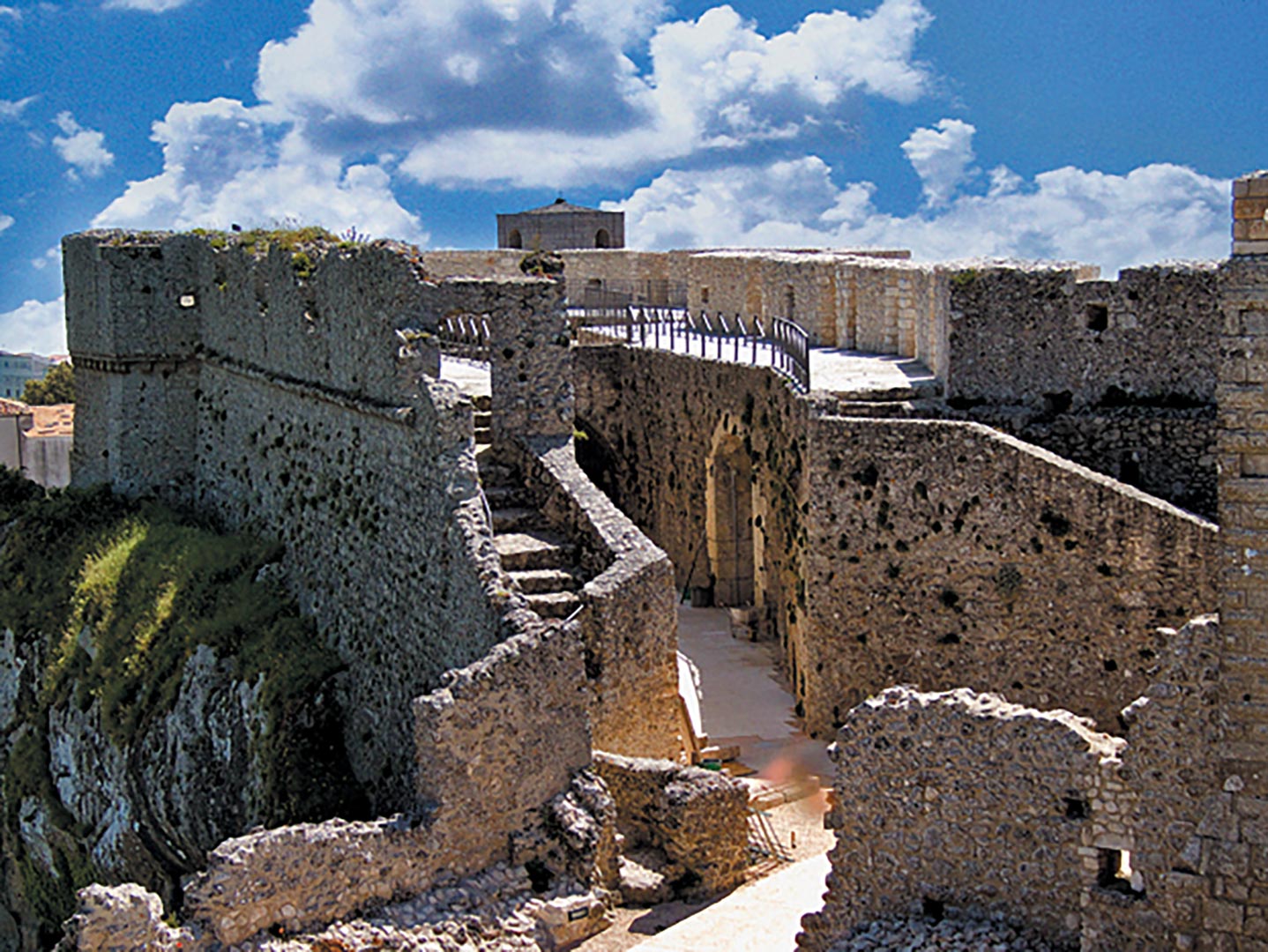
The Castle of Monte Sant’Angelo overlooks the town and the Sanctuary of San Michele from above, thanks to its strategic position atop the rocky outcrop around which the medieval settlement developed. Its current form is the result of a long history of construction, spanning approximately a millennium, through interventions by the Normans, Swabians, Angevins, and Aragonese. Sources trace the earliest fortified structures to the time of Bishop Orso I of Benevento and Siponto, around 837–838, when the Castellum de Monte Gargano is said to have been built. However, the exact nature of this early structure is not entirely clear: historiographical tradition interprets it as a Byzantine-style castrum, while historical and architectural studies highlight the presence of fortified areas predating the major medieval transformations.
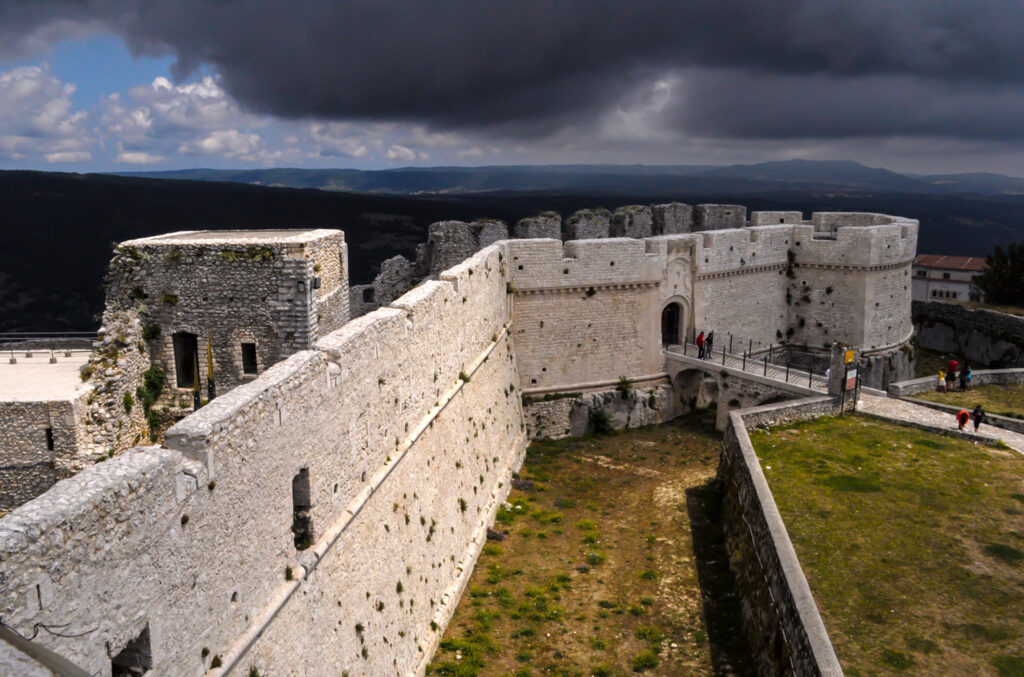
The Norman Period and the Tower of the Giants With the Norman conquest of Southern Italy, the castle took on a central role in the defensive system ofthe Honor Montis Sancti Angeli. Robert Guiscard carried out work on the fortifications and the town’s defensive system in the second half of the 11th century. The Tower of the Giants, a large pentagonal tower approximately 18 meters high and characterized by massive masonry, is traditionally associated with this period. The tower is one of the oldest and most monumental features of the castle.
The Torre dei Giganti is also linked to the tradition of Pilunno, a figure from Italic mythology mentioned by Virgilin the *Aeneid*. Local legend has made him a figure associated with the fortification’s earliest origins, blending folk memory and epic tradition with the monument’s history.
The Swabians and the castrum exemptum In the 13th century, during the reign of Frederick II of Swabia, the castle assumed a position of particular importance within the Crown’s system of fortifications. By a decree issued in Milan on October 5, 1239, Monte Sant’Angelo was included among the castra exempta—fortresses directly subject to imperial authority and exempt from local jurisdiction. The castle thus became part of the network of major military structures controlled by the Crown in the Kingdom of Sicily.
The Treasury Hall, one of the most important rooms in the medieval complex, dates from this period. The hall features a distinctive vaulted ceiling supported by a large central pillar and stands as a significant example of Swabian-era fortified architecture.
The Angevins and the Imprisonment of Philippa of Antioch During Angevin rule, the castle continued to serve military and political functions and was also used as a place of detention. Among the figures linked to its history is Philippa of Antioch, daughter of Frederick of Antioch—the illegitimate son of Frederick II—and wife of Manfredi Maletta. Philippa was imprisoned in the castle, where she died in 1273.
The Aragonese and the Renaissance Transformation Throughout the 14th and 15th centuries, the fortification retained its strategic and political importance. In 1464, Ferdinand of Aragon granted Giorgio Castriota Scanderbeg—an Albanian prince and military commander allied with the Crown—sovereignty over Monte Sant’Angelo and other territories in the Gargano region as a reward for his services to the Aragonese monarchy. After Scanderbeg’s death in 1468, his estates passed to his son, Giovanni Castriota.
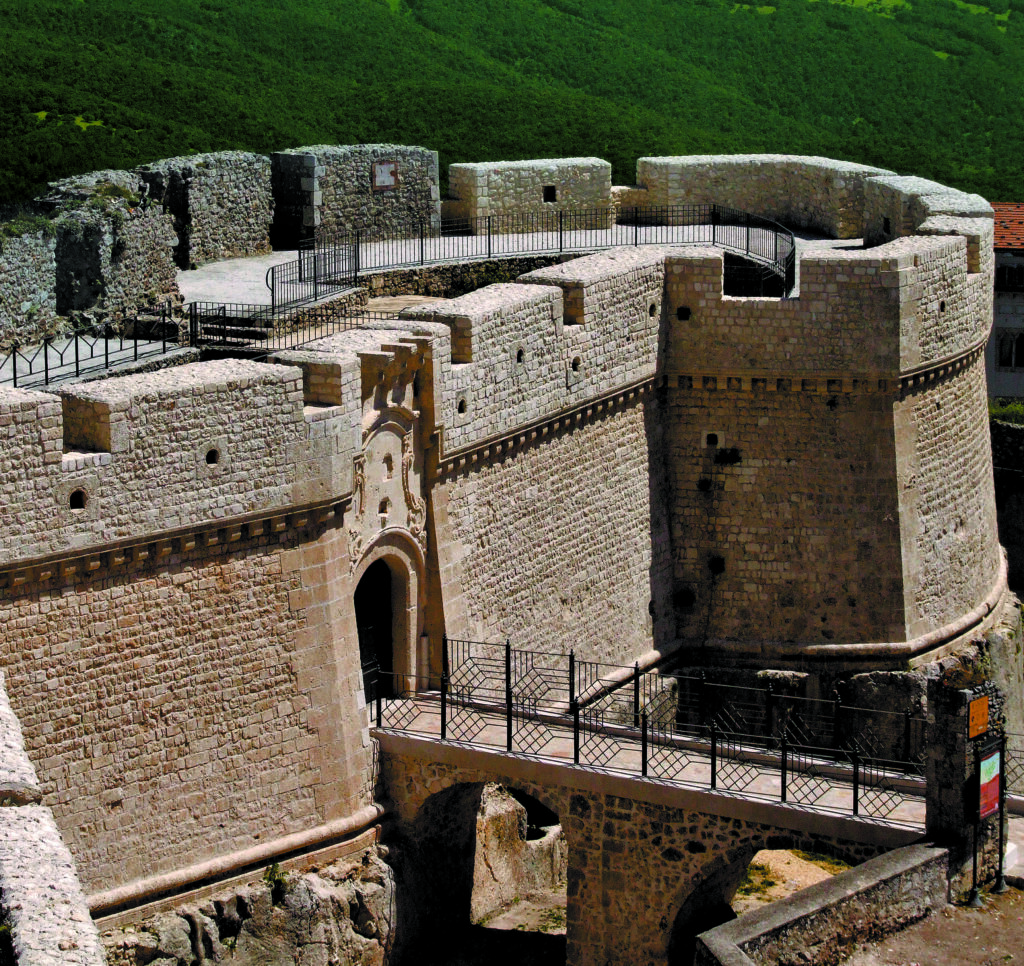
In the second half of the 15th century, the castle underwent a major transformation, driven by advances in military technology and the spread of artillery. Between 1491 and 1497, the system of curtain walls, the towers, the moat, and the fortification’s entrances were reinforced. The new layout included structures designed to withstand the impact of firearms and to improve defensive and firing capabilities.
The name of Francesco di Giorgio Martini, one of the leading theorists and designers of Renaissance military architecture, is associated with this period of construction. His fortification system—based on sturdier masonry, towers designed for the use of artillery, and shapes capable of reducing the effectiveness of enemy fire—was also implemented at the castle of Monte Sant’Angelo. Particularly distinctive is the large tower with an ogival, or “almond-shaped,” plan, which is one of the most recognizable elements of the complex’s Renaissance architecture.
The Feudal Lordship of Scanderbeg, Consalvo de Córdoba, and the Grimaldi Family In 1497, the feudal lordship of Monte Sant’Angelo passed to the Spanish captain Consalvo Fernández de Córdoba, known as the Gran Capitano, a key figure in the conquest of the Kingdom of Naples for the Spanish Crown. In 1552, the fief was purchased by Girolamo Oliva Grimaldi for 30,000 ducats. The Grimaldi family retained feudal control of Monte Sant’Angelo for over two centuries, linking its history to that of the castle and the vast territory of the Gargano.
From the Feudal System to Civic Ownership: In the early 19th century, the feudal system entered its final phase. In 1802, the University of Monte Sant’Angelo—that is, the municipal administration of the time—acquired the fief and its associated rights for a sum exceeding 243,000 ducats. The process of transferring ownership and management of the castle was completed during the nineteenth century, accompanying the fortification’s gradual transition from a military and feudal function to a civic and monumental one.
The Castle Today: The Castle of Monte Sant’Angelo still bears traces of all these transformations. The Tower of the Giants, the medieval rooms, the Treasury Hall, the curtain walls, the circular towers, the Renaissance keep, the moat, and the access system all bear witness to the continuous evolution of a structure that began as a fortified garrison and, over time, became one of the principal historical and architectural symbols of Monte Sant’Angelo and the Gargano region.